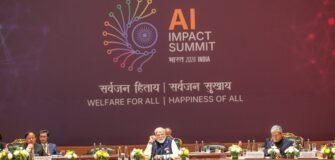


AI Impact Summit 2026: India Positions Itself At Centre Of Global AI Dialogue

Share
AI Impact Summit 2026 has unveiled a plethora of new-age technologies, spanning sectors from education and healthcare to agriculture, manufacturing, public services and digital governance. The showcase reflected how artificial intelligence is steadily moving beyond research labs into classrooms, hospitals, farms and factory floors, shaping everyday systems and decision-making.
The event is in its fourth day and has witnessed a lot of appreciation due to its popularity and the growing interest in artificial intelligence. The scale of the gathering was evident not just in the size of the venue but also in the breadth of ambition on display.
Leaders, researchers and technology thinkers from across the globe had assembled in one place with a shared purpose: to shape how artificial intelligence will be used, governed and harnessed for the world’s future. The event brought together representatives from over 100 countries, signalling India’s growing role as a hub for AI discussion and strategy.
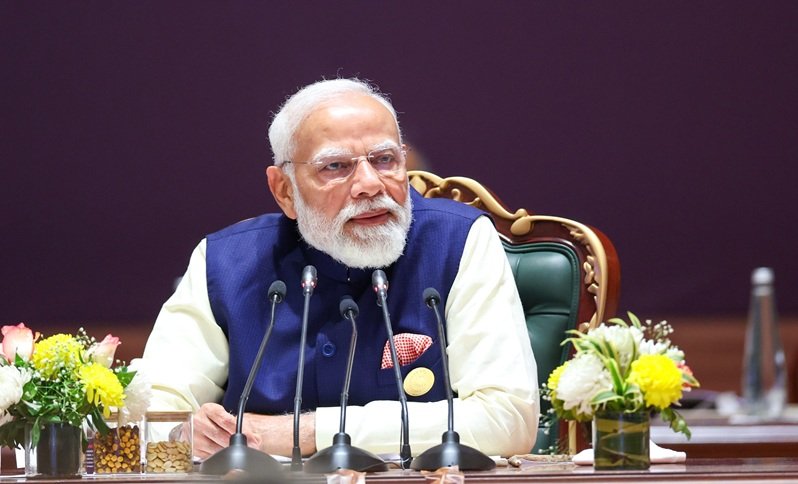
Prime Minister Narendra Modi set the tone in his remarks shared on social media, describing artificial intelligence as “among the biggest transformations in human history.” He articulated India’s unique lens on the technology with a term that reflects both ambition and pragmatism – “MANAV,” the Hindi word for human. For Modi, the goal is clear: to ensure that as AI expands, its benefits are grounded in human welfare and global good, not detached from societal needs.
The prime minister’s message was blunt and forward-looking. He spoke of design and development rooted in India, with outputs that “Deliver to the World” and, importantly, “Deliver to Humanity.” Amid rising excitement about AI’s capabilities, he also acknowledged its dangers. The spread of fabricated content through deepfakes, the erosion of trust in digital spaces and the need to safeguard children online were all underscored as issues that demand collective attention.
That blend of optimism and caution formed the summit’s backdrop. AI’s promise of elevating human capability, from healthcare and agriculture to education and governance, sits alongside growing calls for safeguards and ethical guardrails. For a nation of 1.4 billion people navigating economic and social transition, this dialogue is not abstract: it is deeply practical. Modi’s belief, as reflected in his remarks, is that India can be both a creator and exporter of AI innovations, not merely a consumer of foreign technologies.
Day one of the summit made that ambition visible. High-profile attendees – including heads of state and key technology figures – shared platforms with academicians and startup founders. The message was consistent: collaboration is essential. For India, the event was more than a showcase; it was an assertion that AI policy and innovation should not be the preserve of a few tech capitals. Instead, it should be a conversation rooted in global cooperation, especially among emerging economies.
The summit’s focus also reached beyond immediate technological breakthroughs to consider the broader ecosystem AI will shape. Discussions ranged from data governance and privacy to economic inclusion and workforce upskilling. In Modi’s own words, leveraging AI for the welfare of the planet requires buy-in from governments, civil society and the private sector alike.
Crucially, the summit comes at a time when the world’s understanding of AI is rapidly evolving. Countries are crafting rules and standards even as private industry marches forward with powerful models and systems. India’s approach appears to be one of measured engagement – embracing potential while insisting on frameworks that protect social cohesion and human dignity.
For those at the summit, the narrative was not about hype but responsibility. Watermarking and clear source standards for AI content were highlighted as necessary mechanisms to prevent misuse. Attention to child safety in digital environments was emphasised as a priority. In these discussions, the focus shifted from what AI can do to what it should do, and who gets to decide that.
As New Delhi’s winter sun set over the summit venue, the contours of a new AI conversation were already forming – one that seeks to balance power with purpose, innovation with inclusion. For India, the event was both a milestone and a starting point: a chance to define not just its own AI journey, but to help steer a broader global dialogue towards outcomes that extend beyond code and into the realm of human progress.