


Why Demand For Data Science Graduates Will Skyrocket With AI Revolution

Share

The phrase “a picture is worth a thousand words” holds especially true when discussing trends in technology and the future of work. In this article, we’ll explore why the demand for data science graduates is expected to rise sharply in the years ahead, drawing on compelling data visualizations and real-world examples. But before diving into the numbers, let’s begin with a fundamental understanding of what data science is and why it plays a pivotal role in the age of artificial intelligence (AI).
What is Data Science and Why Does It Matter?
Data science is a multidisciplinary field that lies at the intersection of computer science, statistics, and domain knowledge. At its core, data science involves using algorithms, analytical models, and statistical techniques to extract insights from structured and unstructured data. One of the most powerful applications of data science is its ability to uncover patterns in data—patterns that can be used to train AI systems to make informed decisions or accurate predictions.
To put it simply, data is the fuel that powers artificial intelligence. Consider the example of autonomous vehicles. These systems are trained on millions of images to detect and classify objects like pedestrians, vehicles, and traffic signals. This ability to recognize objects and make real-time decisions is made possible by pattern recognition—one of the fundamental outcomes of data science.
In the business world, another application of data science is “churn prediction,” where companies analyze customer data to identify which users are likely to discontinue their services. By proactively addressing customer concerns or providing incentives, businesses can reduce churn and improve profitability. Such use cases span across industries—from retail and banking to healthcare and logistics—making data science a truly universal skill.
Investment Trends Signal Unstoppable Growth
Let’s now turn to market data to understand why data science is not just relevant, but essential in the decade ahead. As shown in Figure 1 (Goldman Sachs Research), global investments in artificial intelligence have seen a consistent upward trend between 2015 and 2025. These investments are projected to continue growing beyond 2025 as organizations across sectors race to adopt AI-powered solutions.
This surge in investment is not incidental—it is a direct response to AI’s transformative potential. And with greater investment comes a corresponding increase in job creation. The demand for professionals who can build, maintain, and optimize AI systems—data scientists, machine learning engineers, data engineers—is growing rapidly. In short, the job market is expanding in lockstep with capital investments.
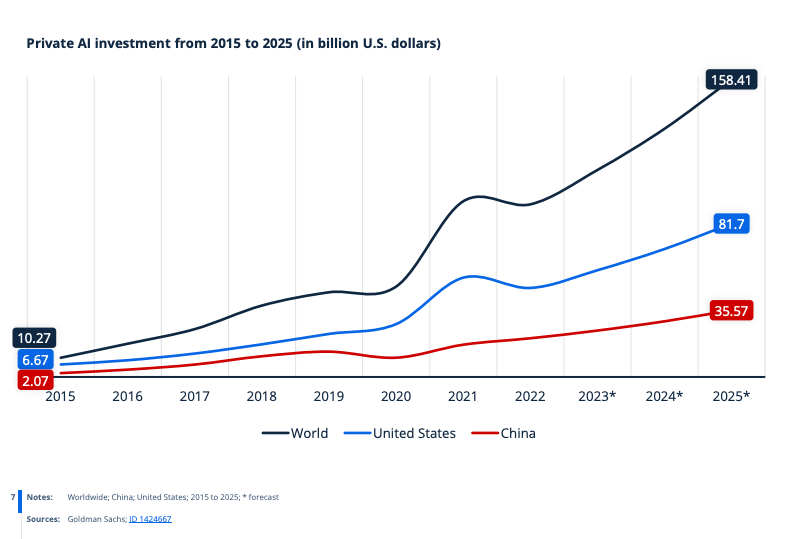
Figure 1
AI Isn’t Just for Tech Companies Anymore
A common misconception is that careers in data science are limited to tech giants like Google, Amazon, or Microsoft. In reality, AI adoption is becoming ubiquitous, touching virtually every industry from agriculture and manufacturing to entertainment and education.
Figure 2 shows the projected market share of AI across different sectors from 2020 to 2031. While projections always carry a degree of uncertainty, the overall trend is unmistakable—AI is becoming a core driver of business value everywhere. Companies whose core business models were once entirely non-digital are now transforming through AI and data science.
Even if there are occasional disruptions—like the dot-com bubble in the late 1990s—history has shown that such events act more as filters than dead-ends. They separate sustainable innovations from hype. Companies like Google and Amazon not only survived the dot-com crash but emerged stronger and more dominant. Similarly, any potential downturn in the AI space would likely be a short-term correction, leading to long-term gains for those equipped with the right skills.
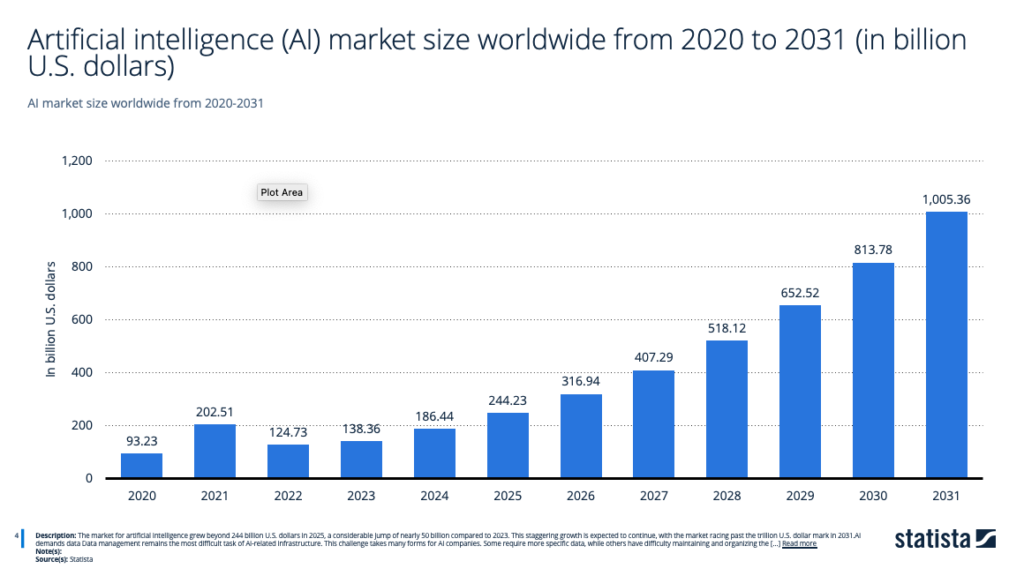
Figure 2
Data Science Skills Are Among the Most In-Demand
A recent skills report (Figure 3) lists the most sought-after competencies in the AI industry in 2024. Unsurprisingly, data science ranks at the top. Skills such as Python programming, SQL, and data visualization—which are core components of modern data science curricula—are among the most in-demand.
Educational programs that focus on industry-relevant training are key to preparing graduates for these roles. For example, SP Jain’s Bachelor of Data Science (BDS) program integrates Python and SQL from the very first semester, ensuring that students build strong technical foundations early on. This alignment between academic training and industry expectations positions graduates for success in a highly competitive market.
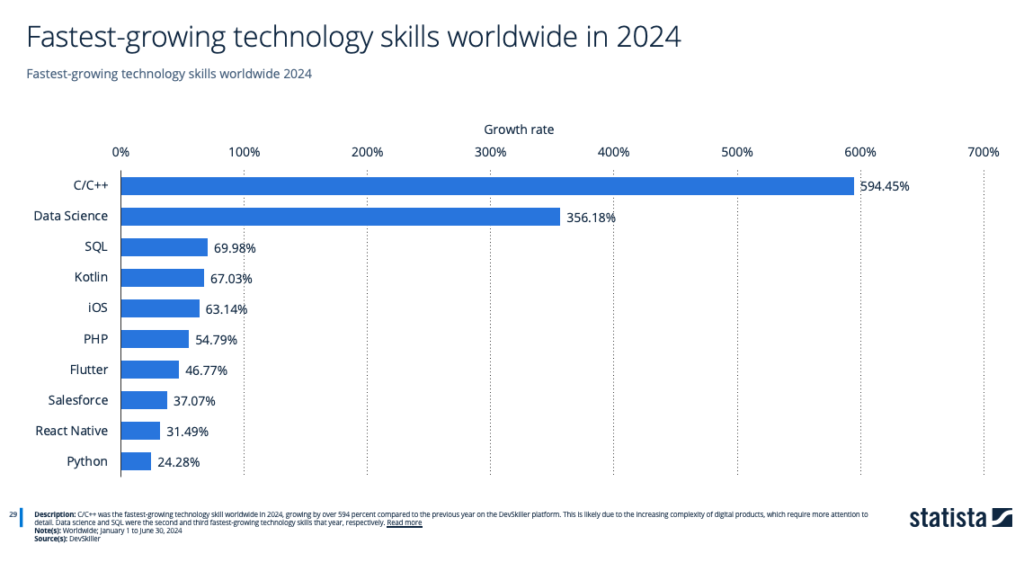
Figure 3
A Generational Opportunity
As we stand on the cusp of a new technological revolution, it’s worth reflecting on the parallels between today’s AI boom and the internet boom of the early 1990s. The rise of the internet gave birth to companies that went on to define the next 30 years—Google, Amazon, Facebook, and others. It is entirely possible that the next global tech giant, born out of AI and data science, is just now being conceived in a startup lab or university campus.
This presents a once-in-a-generation opportunity for aspiring data scientists. Whether you aim to join a leading AI-driven company or dream of building your own, the tools and knowledge you acquire now can position you at the forefront of the next wave of innovation.
In conclusion, the demand for data science graduates is not just growing—it is accelerating. Armed with the right skills, a deep understanding of AI, and a willingness to innovate, today’s students have the chance to lead tomorrow’s world. The AI revolution isn’t coming—it’s already here. And it’s hungry for talent.
Views are personal
The author is Deputy Director – Bachelor of Data Science at SP Jain School of Global Management