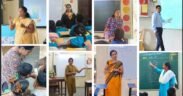


India As The World’s Top Experiential Learning Center

Share

A few years ago, a group of visiting students sat inside a family-run textile business in Surat, watching the third generation argue, gently but firmly, over whether to automate a process their grandfather had built by hand. No case study could have captured that tension the way sitting in the room did. That is the moment experiential learning stops being a phrase in a brochure and becomes real.
For generations, learning has meant classrooms, textbooks and teachers: study a concept, study an example, then work out how it behaves in the real world. But some lessons are only learned by living through them, and India offers an unusually rich place to do that. Its businesses, entrepreneurs, communities, cultural diversity and sustainability challenges create a living environment where students and executives can watch ideas being tested every day.
India, then, is not just a destination to visit. It can become a classroom in itself.
Business That Brings Lessons to Life
India’s business landscape is full of these moments. Many family-owned companies have run for generations while adapting to new technology, shifting customer expectations and rising competition, all while preserving their values and handing leadership to the next generation. Sitting with such leaders teaches succession planning, governance and change in a way no textbook chapter on “family business dynamics” ever could.
India’s startup ecosystem offers a different kind of lesson. Entrepreneurs across the country are tackling problems in technology, financial services, healthcare, education, mobility and sustainability. With 2.23 lakh startups now recognised by the Department for Promotion of Industry and Internal Trade (DPIIT), India is the world’s third-largest startup ecosystem, a scale that gives learners an enormous live laboratory.
But the more interesting question is rarely “how did this startup succeed?” It’s “what actually happened along the way?” What problem did the founder first notice, maybe on a crowded train or in a family kitchen? What fell apart in year one? How did the model change once the first hundred customers said no? Ask a founder these questions, and entrepreneurship stops being theory and becomes a story with real stakes.
Learning from the Grassroots
Learning in India doesn’t stop at large corporations and startups. Some of the sharpest lessons come from rural entrepreneurs and small, community-based enterprises — a dairy cooperative building its own cold-chain logistics on almost no capital, or a self-help group turning a single sewing machine into a garment business. These entrepreneurs work with limited resources yet find practical ways to solve local problems and create livelihoods.
For students, watching this up close teaches resourcefulness and resilience, and shows that innovation doesn’t always need advanced technology or large investment. Sometimes constraints themselves create innovation, a lesson that matters enormously, since many of the world’s emerging markets operate under exactly these conditions.
Cultural Diversity as a Curriculum
India can also teach something rarely found in a textbook: cultural intelligence. Different languages, food, traditions and regional identities are part of everyday life here, and they shape how people communicate, build trust, negotiate and decide. A visiting learner who tries to close a deal in Chennai the way they might in Delhi quickly discovers the playbook has to change.
For an international learner, moving through these environments demands observation and listening, and forces people to question their assumptions and take seriously perspectives different from their own — skills anyone working across countries and cultures needs. Cultural intelligence isn’t built in a lecture hall; it grows through interaction.
Sustainability Through Real-World Experience
India offers an equally important classroom for sustainability. Communities and businesses across the country are finding ways to manage resources, cut waste and respond to challenges around energy, water, mobility and the environment, while large organisations experiment with renewable energy, water recycling and cleaner production. A farmer using drip irrigation to stretch a shrinking water table teaches the same lesson as a manufacturer redesigning a supply chain: sustainability is a set of trade-offs, not a slogan.
For learners, the value lies in seeing how these ideas hold up in practice. Rather than discussing sustainability only through slides, students can ask what actually works, what it costs, what compromises it demands, and whether it would scale. This reflects the broader Immersion India view of sustainability as an operating challenge, not simply an aspiration.
From Seeing to Learning
Simply visiting India, however, does not automatically create experiential learning. A presentation, a factory tour or a conversation with an entrepreneur can be interesting on its own, but real learning begins only when students reflect on what they’ve observed. What surprised them? Which assumptions changed? Why did a model work, and what failed before it did?
That reflection is the difference between exposure and education. A meaningful immersion programme has to connect every experience to a clear learning objective, the goal isn’t to show participants an impressive India, but to help them understand how India actually works.
India as a Living Classroom
The strength of India as an experiential learning destination doesn’t live only in its universities. The classroom can be a family-run business, a startup, a manufacturing floor, a rural enterprise, or one honest conversation with an entrepreneur explaining why an idea that looked perfect on paper fell apart the moment it met a real customer.
That is where experiential learning becomes powerful, where students move from reading about entrepreneurship to meeting entrepreneurs, from studying culture to living inside cultural difference, and from discussing sustainability to watching how people respond to real constraints.
The future of education won’t mean choosing between textbooks and experience, rather connecting the two. India offers an extraordinary place for that connection, a country whose diversity, entrepreneurship and constant motion can hand learners something no textbook can fully reproduce: the chance to watch ideas collide with reality.
That is why India has the potential to become one of the world’s most important experiential learning centres.
India does not simply offer a classroom to the world. India itself can be the classroom.
Views expressed are personal
The author, Vineeth Thomas, is Founder & Managing Partner, Immersion India