

Beyond the Hunger Strike: Why Jantar Mantar Is Drawing India’s Youth

Share
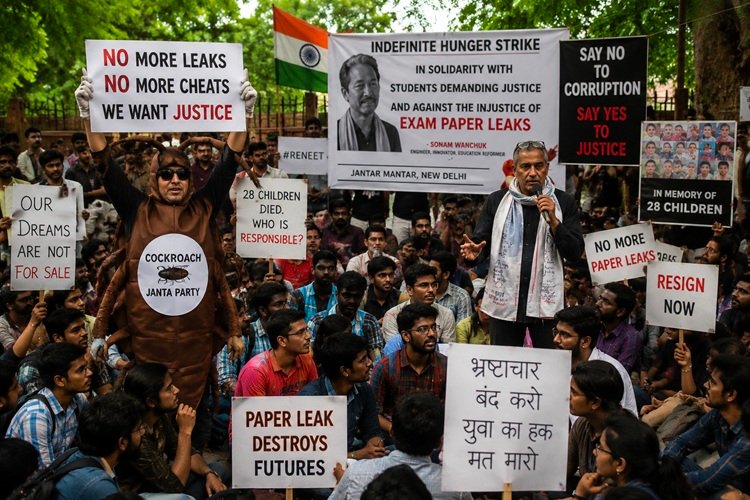
On July 14, Jantar Mantar was packed the way it’s been most evenings for weeks now — students, activists, political workers, journalists, and plenty of people with no formal affiliation at all, standing around a protest that started small and has since turned into one of the more closely watched sit-ins in recent memory.
The demands on display were layered: accountability from the government, action on repeated exam paper leaks, and justice for the 28 children whose deaths have become a rallying point at the site. Some in the crowd wanted Education Minister Dharmendra Pradhan to resign outright; others were more cautious, saying due process should run its course before anyone draws conclusions. What almost everyone agreed on, regardless of where they landed on specifics, was that the concerns being raised shouldn’t be brushed aside.
The Man at the Centre of It
At the heart of the protest is Sonam Wangchuk — the Ladakh-based engineer-turned-activist whose earlier work inspired a character in 3 Idiots, and who has, by this point, built a long track record of using hunger strikes to force attention onto causes he believes are being ignored. He’s fasted before over Ladakh’s demand for statehood and constitutional safeguards; this time, the fast is in solidarity with a very different, much younger movement.
Wangchuk began an indefinite hunger strike on June 28, in support of Abhijeet Dipke, the founder of the youth-led Cockroach Janta Party (CJP), who has been staging his own sit-in at the same site demanding Pradhan’s resignation over the paper leaks that disrupted a major national entrance exam earlier this year. By July 14, Wangchuk was 17 days in, visibly weaker, and — according to those around him — still refusing to stop despite mounting concern over his health. Opposition leaders have publicly urged him to end the fast; the government and Pradhan’s ministry have not issued a detailed public response to the specific demand for his resignation.
It’s worth noting the protest hasn’t been treated as adversarial in a physical sense — there’s been no attempt by police to shut the site down, and organisers describe it as remaining peaceful throughout, even as tensions and health concerns have grown.
What Students Actually Came to Say
For a lot of the younger people at Jantar Mantar, the paper leaks are the part that stings personally. Several aspirants described sleepless nights, months of preparation, and the particular kind of disappointment that comes from finding out an exam you’d built your year around may have been compromised before you even sat for it. Nobody framed it as asking for sympathy. The ask, repeatedly, was simpler than that — just a fair shot at competing on equal terms.
Satire, Cameras, and a Cockroach Costume
Not everything at the site was solemn. One participant showed up dressed as a cockroach — a nod to the CJP’s name and branding — using humour and satire to pull people into a conversation they might otherwise have scrolled past. It worked; the costume drew a crowd of its own and got people talking, which is arguably the entire point of protest theatre like this.
Political leaders, social activists, and a steady rotation of media crews moved through the ground throughout the day, collecting opinions that ranged from calls for immediate resignation to appeals for slower, structural reform. If there was one thing the day made clear, it’s that this movement — organised loosely, without the usual party structure — contains a lot more disagreement within it than outside coverage sometimes suggests.
A Quiet Moment for the Children Who Didn’t Come Home
The gathering’s most emotional stretch came during the tribute to the 28 children who died — moments of silence, posters held up in the crowd, and a shared, unspoken hope that whatever failures led to those deaths don’t repeat themselves. The noise of the protest fell away for those few minutes in a way that stood out against everything else happening around it.
What Comes Next
As of mid-July, the situation remains unresolved: Wangchuk continues his fast, CJP has reportedly been preparing supporters for a march to Parliament later in the month, and the government has yet to signal any change in position on Pradhan’s resignation. Whether the strike ends through negotiation, health complications, or simply the pressure of public attention is, at this point, still an open question.
What’s clear from the ground is that this isn’t a single-issue protest anymore. It’s become a meeting point for several unresolved grievances — exam integrity, accountability, and a broader frustration with institutions many young protesters feel have stopped listening — all converging, for now, on one man’s decision to keep fasting until something changes.