

Honeywell Launches STEM School Programme, Targets 12,000 Students By 2029

Share
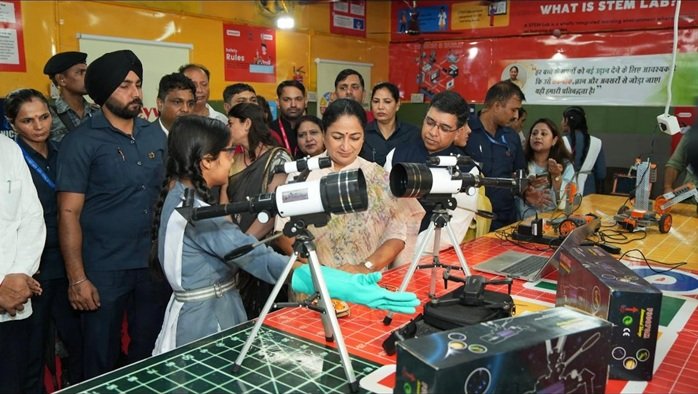
A government girls’ school in Shalimar Bagh Village that Delhi Chief Minister Rekha Gupta once described as leaving her “disappointed” on an earlier visit has now become the launch site for Honeywell Technologies’ newest push into school education — a STEM-focused transformation programme that the company says will eventually touch more than 12,000 students across four Indian cities.
The programme, inaugurated by Gupta at the Shalimar Bagh Village Government Girls Senior Secondary School, marks a fresh milestone under Saksham, Honeywell’s flagship education and skilling initiative in India. Over the next three years, the company plans to work with 12 government and government-aided girls’ schools nationally, with the heaviest concentration of the effort — nearly 5,000 students — landing in Delhi. Pune, Bengaluru and Gurugram round out the remaining cities.
Unlike a straightforward infrastructure grant, the programme is built around four pillars: STEM education, digital literacy, student well-being, and teacher development. Honeywell is running it in partnership with the Ladli Foundation Trust, combining upgraded learning infrastructure with teacher training and what the company calls “global exposure opportunities” for students.
At Shalimar Bagh, that global exposure has already taken concrete shape. Officials at the inauguration announced that four students from the school will travel to a research centre in the United States — a detail that drew visible excitement from the gathered students, according to those present at the event.
From Disappointment to a Model School
Gupta didn’t hold back in contrasting her two visits to the school. She recalled being unimpressed by its condition the first time around; this time, she said, she found a campus transformed enough to rank among the better government schools in the city, pointing to the new AI-enabled facilities and modern computer labs as evidence of how far it had come.
Beyond the school itself, Gupta used the platform to lay out a broader set of commitments for Delhi’s students. She spoke of distributing school bags, extending support to girls through the Ladli Yojana scheme, handing out bicycles to 1,200 students, and pushing more girls to obtain their Pink Cards. Looking ahead, she outlined plans for a model school in Haiderpur, a citywide push to replace exposed electrical wiring for campus safety, a target of planting 70 lakh trees, promotion of the government’s EV policy, and a drive to ensure HPV vaccination coverage for girls. She closed her remarks with “Jai Hind! Jai Bharat!”
The Infrastructure Story Behind the Headlines
The two officials who spoke alongside the Chief Minister filled in the less glamorous — but arguably more consequential — details of what “transformation” has actually meant on the ground.
Ashish Modi walked through the school’s recent upgrades in some detail: the introduction of a Science stream, AI-enabled facilities, renovated washrooms, and a broader push toward digital education. He argued that government schools today are closing the gap with private institutions in terms of facilities, and urged students to make full use of what’s now available to them.
Devender took a more direct tone with the students and staff in the room. “Don’t do things just as a formality — if you do something, give it your best,” he told them. He pointed to a string of practical improvements — new jet pumps, cleanliness tracked through digital monitoring, and computer labs now up and running in 225 schools — as evidence that the changes went beyond cosmetic fixes. He also flagged the rollout of Manobal Kits, a mental health and stress-management resource for students, and noted that ageing electrical wiring at the school had been replaced through a ?69 lakh project backed by Tata Power, a move he framed as a straightforward safety upgrade rather than a headline-grabbing one.
What Comes Next
For Honeywell, Shalimar Bagh is the first stop rather than the destination. With 11 more schools still to come under the Saksham programme and a 2029 target of 12,000 students, the real test will be whether the mix of AI-enabled classrooms, teacher training and international exposure trips can be replicated at similar scale and quality across Pune, Bengaluru and Gurugram — cities with very different starting points and very different school systems to work within.