

“If We Give Children Freedom, Tools & Emotional Safety, They Don’t Just Learn — They Thrive”

Share
In India’s fast-changing education space, one idea is slowly moving from the margins to the mainstream. More parents are beginning to question what children really gain from long school hours, heavy textbooks and exam pressure. At the same time, alternatives like homeschooling and experiential learning are finding new takers, especially after the pandemic reset how families view learning.
For Dinesh Gupta, this shift is not surprising. As the founder of Vikalp India, he has spent years working at the intersection of traditional schooling and new-age learning models. His approach challenges some of the most deep-rooted ideas in Indian education, from rote learning to the belief that classrooms are the only place where real learning happens.
In this conversation, Gupta talks about why homeschooling is shedding its stigma, why parents are rethinking the value of schools, and what it takes to build a system where children learn by doing, not just memorising.
Homeschooling still carries a bit of a stigma in India — parents worry their kids will miss out socially. What do you tell them?
Homeschooling in India carries a stigma largely because we equate social development with physical classrooms. We tell parents that this assumption needs to be questioned.
Social growth is not about sitting in a room with 40 students—it’s about the quality of interaction, emotional safety, and the ability to express oneself. In many traditional setups, interaction can be limited or even driven by comparison and pressure.
At Vikalp, we place a strong emphasis on emotional and socio-emotional development. We conduct dedicated socio-emotional classes and consciously nurture confidence, empathy, and communication skills. We’ve seen students who were initially hesitant become far more expressive and self-assured over time.
For physical development, we encourage students to actively participate in sports and hobby-based activities. We have also partnered with multiple academies to ensure children have access to structured opportunities beyond academics.
Holistic development doesn’t come from a single system—it comes from a well-designed ecosystem. When children are supported emotionally, socially, and physically in the right way, they don’t miss out—they often thrive beyond conventional expectations.
Is homeschooling only for a certain kind of family, or do you see it going mainstream in India?
Today, many parents are rethinking the value of traditional schooling itself. A question we increasingly hear is: We send our children to school for 8 hours—what are they really gaining in return?
This reflection is important. Parents are beginning to see that long hours in a physical school do not always translate into meaningful learning, emotional growth, or individuality.
At the same time, there is a deeper shift happening. Parents want to be present in their child’s growing years—they don’t want to outsource childhood. They are looking for ways to stay connected, to be part of their child’s learning journey, rather than stepping away from it.
So, is homeschooling going mainstream?
It may not replace traditional schools entirely, but it is clearly becoming a strong and credible parallel system.
With the rise of structured online models and support ecosystems, homeschooling is no longer limited to a niche segment. It is becoming a conscious choice for families seeking better alignment with their values.
“Homeschooling is no longer about opting out of school—it’s about opting into a more intentional way of raising and educating children.”
How is the conversation around alternative education different today compared to five years ago?
Earlier, it was seen as fringe or experimental—something only a small group of parents explored, often with hesitation and social pressure. Today, it has moved into the mainstream conversation.
What has changed?
Five years ago, the question was: “Is alternative education even viable?” Today, the question is: Is traditional education enough? Parents are far more aware and discerning now. They are questioning:
The effectiveness of rote learning
The pressure-driven environment
The real outcomes of spending long hours in school
In fact, many parents openly ask: f my child spends 6–8 hours in school, what meaningful learning or development is actually happening?
At the same time, there is a stronger emphasis on:
Emotional and mental well-being
Personalised learning journeys
Flexibility and real-world relevance
Parents don’t just want academic success—they want balanced, confident, and self-aware children.
What enabled this shift?
The pandemic normalized online learning
Technology made quality education more accessible
Success stories from alternative models built trust
“Five years ago, alternative education had to prove it works.
Today, it is traditional education that is being questioned.”
Rote learning has been the backbone of Indian education forever — why is it so hard to let go of it?
Rote learning has persisted in India not because it is effective, but because it is deeply embedded in the way our education system was originally designed. If we go back in history, modern schooling evolved after the Industrial Revolution. The purpose then was clear: to prepare students for factory jobs—structured, repetitive, and process-driven.
So the system was built like a factory itself:
Standardised curriculum
Uniform pace
Batch processing of students
Predictable outputs
In such a model, rote learning was not a flaw—it was a feature.
Why is it so hard to move away from it today?
Because the entire ecosystem still operates on that legacy:
Teachers are trained in it
Assessments reward it
Schools depend on it for consistency
Parents are conditioned to trust it
Changing rote learning means changing the DNA of the system. But the world it was designed for no longer exists We are now in a rapidly evolving, technology-driven economy. With the rise of AI, most repetitive, rule-based jobs are at risk of being automated.
So the real question is:
Where will students trained only in memorisation and repetition fit in this new world? What the future demands
Today, the need is completely different:
Critical thinking
Problem-solving
Creativity
Adaptability
In the age of AI, knowing answers is less important than knowing how to think.
“Rote learning belongs to a factory-era system.
But we are preparing children for an AI-driven world—the mismatch is too big to ignore.”
What does “experiential learning” actually look like in practice for a 10-year-old sitting at home?
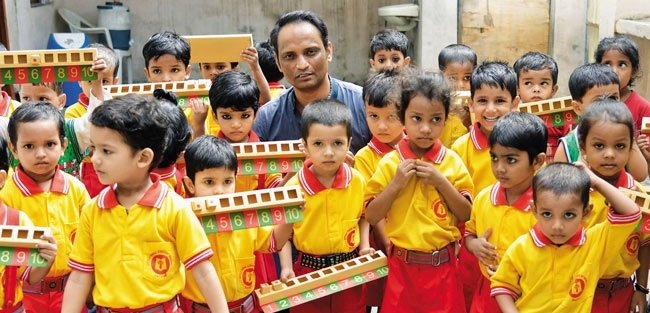
Experiential learning, even at home, is far more practical than people imagine. It simply means that a child doesn’t just hear or memorise a concept—they experience it, explore it, and discover it.
For a 10-year-old, this can look very simple and natural. What does it look like in practice? Instead of being told a concept, the child engages with it:
Math is not just numbers on paper—
it could be measuring or using hands-on tools to understand fractions and trigonometry
Science is not definitions—
it could be simple experiments or observing real-life phenomena
Language is not rote grammar—
it becomes storytelling, discussions, and expression
What changed in the online environment
For a long time, online education was seen as boring.
Teachers used whiteboards or presentations, and students would eventually lose interest—often just staring at the screen. At Vikalp, this changed with the implementation of experiential learning in online classes.
Now, instead of just watching, students are actively involved:
Teachers ask them to take out learning tools
Students perform activities during the class
They do first, and then understand the concept
This shift—from passive listening to active doing—changed everything. Students became active learners. Learning became enjoyable, and concepts started connecting with real life.
One practical challenge is that students don’t have learning tools for every concept at home. To solve this, Vikalp designed and manufactured concept-based learning tools and delivered them directly to students’ homes.
This ensured that:
Every child has access to the right tools
Learning starts with hands-on experience
Theory follows practice, not the other way around
“Experiential learning at home is not about adding more—it’s about changing how learning happens. When children start by doing, understanding naturally follows.”
How do you measure whether a child is actually learning better — not just scoring better?
At Vikalp, we don’t rely only on summative exams like half-yearly or final tests.
Instead, we place greater emphasis on formative assessment—evaluating students continuously as learning is happening. This allows us to understand not just what a child knows, but how they are learning.
Our assessment is based on Bloom’s Taxonomy, where we evaluate a child across six levels:
Remembering
Understanding
Applying
Analyzing
Evaluating
Creating
This helps us track the full journey—from basic recall to higher-order thinking and creativity.
The real shift
“Marks measure performance for a moment.
Learning reveals itself in how a child thinks over time.”
Running an education platform in India means competing with some very established names — what’s your edge?
It’s true—India has some very established players in education. But we don’t see ourselves competing on the same parameters. Most platforms compete on:
Content
Technology
Scale
Our edge lies in something more fundamental:
We don’t just deliver education—we redesign how learning happens.What makes Vikalp different
Learning by Doing, Not Watching
Many platforms are still content-driven—videos, lectures, or recorded explanations.
At Vikalp, learning is experiential.
Students actively engage, perform activities, and discover concepts during the class.
The shift is from consuming content to creating understanding.
- From Passive to Active Learning (Even Online)
Online education was often seen as passive.
We changed that by:
Integrating learning tools into every concept
Making students participate in real-time
Designing sessions where they do first, then learn
- Full Ecosystem, Not Just Classes
We didn’t stop at teaching.
We built:
Concept-based learning tools delivered to students’ homes
A system where practice comes before theory
Strong focus on emotional and socio-emotional development
- Focus on Outcomes, Not Just Scores
We measure success not just by marks, but by:
Understanding
Application
Confidence
Curiosity
The real edge
Our edge is not better content—it’s a better learning experience.” In a crowded market, differentiation doesn’t come from doing more. “It comes from doing something fundamentally different—and doing it deeply.
Two decades in education — what’s the one thing that still surprises you about how children learn?
Even after two decades in education, what continues to surprise me is how naturally curious and capable children are—if we don’t interrupt the process. We often assume learning has to be driven, structured, and pushed. But in reality:
Children are wired to learn—they don’t need to be forced, they need the right environment.
What we’ve consistently observed. When children are given:
Freedom to explore
Opportunities to do, not just listen
A safe space to ask questions
They learn faster, deeper, and with far more enthusiasm than we expect.
In fact, some of the most powerful moments are when:
A child explains a concept in their own unique way
Connects it to real life
Or asks a question we didn’t anticipate
That’s when you realise learning is happening at a much deeper level. The real surprise. The problem is not that children don’t learn. It’s that systems often get in the way of how naturally they learn. If we stop over-directing and start enabling, children don’t just learn better—they exceed our expectations.
Where do you see Vikalp India three years from now?
Three years from now, we see Vikalp India playing a much larger role—not just as an online school, but as a catalyst for transforming how learning happens across systems.
What does that look like?
First, expanding our online school. Vikalp Online School is already serving students globally. Over the next few years, we aim to expand to most of the countries and significantly grow our global footprint. We are also looking to expand the scope of our online school by offering multiple international curricula, moving beyond our current two-option structure, so that families have greater flexibility and choice.
Second, scaling our partnerships with physical schools. Alongside this, we will continue to deepen and expand our work with physical schools. Currently, we partner with hundreds of private schools and four state governments, helping them transition from traditional blackboard teaching to experiential learning models. Our goal is to scale this impact to thousands of private schools and eventually across all state government school systems.
Our goal is not limited to one format—online or offline. It is to make experiential learning accessible, scalable, and mainstream—across geographies and systems. If in the next three years, more children—across countries and classrooms—are learning with understanding, curiosity, and confidence, that’s when we know we are on the right path.
What is your take on the new syllabus as books are not available and schools have already released new sets at a higher price?
The situation reflects a deeper challenge in how we approach curriculum changes in India. On one hand, reforms inspired by frameworks like NCERT are important and necessary. Updating the syllabus to make learning more relevant and aligned with current needs is a positive step.
However, the execution is where the gap appears. When books are not readily available, yet new sets are released at higher prices, it creates:
Confusion for parents
Financial pressure
Disruption in the learning process
We are still operating in a system where:
Learning is tightly linked to textbooks. Schools depend heavily on prescribed materials
So any delay or mismatch directly impacts students and families. This is actually an opportunity to rethink:
Should learning be dependent on books alone?
With the right approach: Concepts can be taught through activities
Understanding can be built without waiting for perfect materials
Learning can continue even in uncertainty
At Vikalp, our approach is different. Since our model is experiential, learning does not stop due to book delays.
Students engage with concept-based tools and activities
They understand first, and then connect with theory
Books become a reference—not the foundation
“Curriculum change is necessary—but it must be matched with thoughtful implementation. Otherwise, we risk changing content without improving learning.”