

How Data Is Helping Teachers Personalise Learning Like Never Before

Share
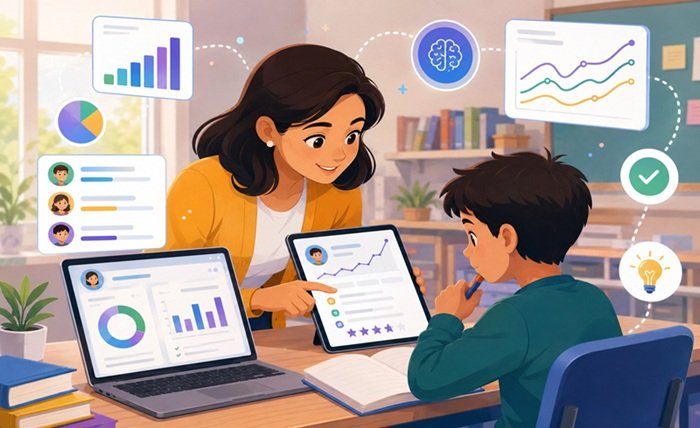
For decades, classrooms have followed a single pattern with one teacher, one syllabus, and many students expected to learn at the same pace. That model is now shifting quietly, driven by one core element called data. Not just exam scores, but continuous learning data that helps teachers understand how each student learns, where they struggle, and what support works best. Across India, adaptive and AI-enabled learning platforms are becoming a bridge between teaching and actual learning outcomes. These systems track response time, accuracy patterns, practice attempts, and concept-wise mastery. Their real value lies not in collecting data, but in turning it into actionable classroom insights.
Education policy discussions under the Ministry of Education and the broader direction of National Education Policy 2020 increasingly emphasise competency-based learning, shifting focus from rote memorisation and syllabus completion towards deeper conceptual understanding and skill development. At the same time, some schools and Edtech platforms are using digital learning tools to identify concept-level gaps and support targeted teaching interventions. Through quizzes, practice exercises, assignments, and assessments, these platforms generate insights that help teachers identify where additional support is needed. While adoption still varies across schools and regions in India, such tools are gradually influencing how learning support and classroom interventions are approached.
Data in action inside real classrooms
Consider a government school in Andhra Pradesh, where a mathematics teacher handles a class of 45 students. Earlier, she would teach “fractions” uniformly to the entire class, assign practice work, and review performance later through notebooks or tests. Today, in some blended learning environments supported by digital tools, teachers can review learning patterns from weekly activities instead of waiting for major tests.
These patterns help identify gaps before the lesson begins. Some students may struggle with identifying basic fractions, while others may understand the concept but find word problems difficult. Another group may already be comfortable with application-based exercises. Such insights help teachers plan targeted support, recommend additional resources, organise small-group interventions, and adjust revision sessions according to different learning needs within the same classroom.
The difference is what happens next
Instead of repeating the same explanation for all 45 students, the teacher adjusts her approach using platform data. Students who need support receive step-by-step remedial practice, those slightly ahead work on guided problem-solving exercises, and advanced learners are given application-based challenges.
This approach also supports different learning styles within the classroom. Some students learn better through visual explanations, others through hands-on practice, discussion, or repeated exercises. Data-driven learning platforms help teachers identify these patterns and adapt teaching methods for visual, auditory, and kinesthetic learners.
In the same classroom, multiple learning journeys take place simultaneously. The teacher remains central to the process, but now works with clarity instead of guesswork. This is where Edtech platforms become meaningful. They do not change what is taught, but help teachers clearly identify learning gaps and respond to them in real time.
From “one pace for all” to “individual learning paths”
One of the biggest shifts data-supported learning brings is greater flexibility in how students progress through concepts. In traditional classrooms, teaching often moves at the same pace for everyone, even though students learn differently and at different speeds. In blended learning environments, digital platforms help teachers identify which students need additional practice and which are ready for advanced or application-based exercises.
Using data from quizzes, assignments, and assessments, teachers can adjust support according to individual learning needs. This aligns with the competency-based learning approach encouraged under the National Education Policy 2020, where the focus is on skill development and conceptual understanding rather than only syllabus completion or broad scores. In practice, this helps teachers respond more effectively to varied learning needs within the same classroom.
Why this matters in the Indian classroom context
India’s classrooms are naturally diverse, with teachers often managing students at very different learning levels in the same room. National learning assessments have consistently highlighted gaps in foundational literacy and numeracy, showing that students do not always learn at the same pace. This has made competency-based learning and targeted academic support increasingly important in India’s education system.
This is where digital platforms become valuable. Instead of replacing teaching, they help teachers better understand where each student stands through continuous progress tracking rather than relying only on end-of-term assessments.
Continuous tracking can also improve parent-teacher collaboration. With better visibility into student progress and learning gaps, discussions become more focused on supporting improvement instead of only reviewing final exam results.
A quiet but meaningful shift in teaching itself
What is emerging is not a technology-first classroom, but a teacher-led learning environment supported by data-driven insights. In blended learning settings, digital platforms help teachers identify learning patterns, plan revision strategies, and provide targeted support more effectively. The teacher remains central to the process, while technology acts as a support system that makes teaching more focused and adaptable. Although government policies and digital education initiatives encourage this shift, adoption still varies across schools and depends on how institutions integrate these tools into everyday learning.
The takeaway
Personalized learning in India is moving from policy to classroom practice. NEP 2020 sets the direction, while learning platforms help teachers understand how each student learns. With better learning insights, teaching shifts beyond syllabus completion towards real understanding.
Views expressed are personal
The author, Praveen Singh is CEO, AASOKA (A part of MBD Group)