


Inside COER University’s Plan To Build Its Own AI Tools

Share
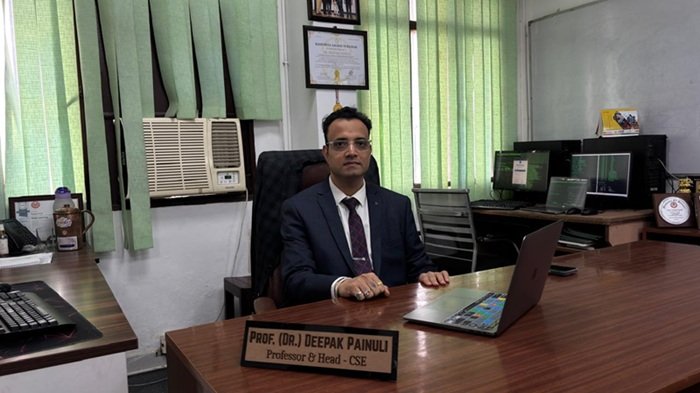
Prof. Deepak Painuli, Professor and Head of the Department of Computer Science and Engineering, explains how faculty and students are building the AI tools the campus will run on.
At COER University, the people building the university’s AI tools aren’t an outside software company. They’re the university’s own students and faculty. “All the tools we were taking from vendors are now being developed by our students and our team,” says Prof. Deepak Painuli, Professor and Head of the Department of Computer Science and Engineering at COER University, Roorkee.
Along with running the department, Prof. Painuli co-chairs the university’s AI task force, set up to make COER an AI-powered campus. The team has been working on it for the past six months, and he expects the university to be fully AI-powered within the next month or two. The plan starts with teachers. Once faculty are comfortable with AI, Prof. Painuli says, they can pass the same skills on to students.
Training began during the summer break. Since the semester started, it has continued on Saturdays, which are otherwise non-working days for faculty. Around 250 faculty members from across the university and departments are part of it. The training happens in two stages. First, all faculty learn a common set of general-purpose AI tools. Then each department moves to tools built for its own subject, whether that’s computer science, AI and machine learning, medical sciences, management or civil engineering. Teachers can now prepare lecture plans and course material from the syllabus in about a minute, he says.
Tools Built On Campus
Much of the development happens in-house, on the university’s high-performance computing systems, where AI models are being trained. One of the first tools is for exams. A faculty member uploads the full syllabus once, and the tool generates around 200 questions sorted by difficulty level. From that bank, it can randomly create several sets of question papers. The tool is connected to the university’s ERP system.
Another tool helps with evaluation. It checks students’ answers by matching them against the context and content of the expected answer. Correcting mid-semester and end-semester papers usually takes faculty a lot of time. Faster evaluation means results come out sooner, so students can move ahead with their next applications without waiting.
Paid Student Developers
Students are at the heart of the work. Those who join the project as interns are paid a stipend of ₹10,000 a month, and they work on the tools after classes. For Prof. Painuli, building the tools on campus serves a clear purpose. Subscriptions to commercial AI platforms come with costs and limits on usage, and the university wants to reduce its dependence on outside vendors by creating its own utility tools, tailored to how the university actually works.
The larger goal, he says, is that AI should take over routine, time-consuming tasks, so faculty can spend more of their time on teaching, mentoring and research. Beyond reducing dependence on external technology providers, the initiative aims to give students hands-on experience in developing real-world AI solutions. Building tools that are actually implemented across the university gives students practical industry exposure, a sense of ownership and the satisfaction of seeing their innovations come to life. It prepares them to enter the professional world not just as users of technology, but as creators of it.