

Manufacturing Growth Expected to Moderate in Q-1 Due to effects of West Asia Crisis: FICCI Survey

Share
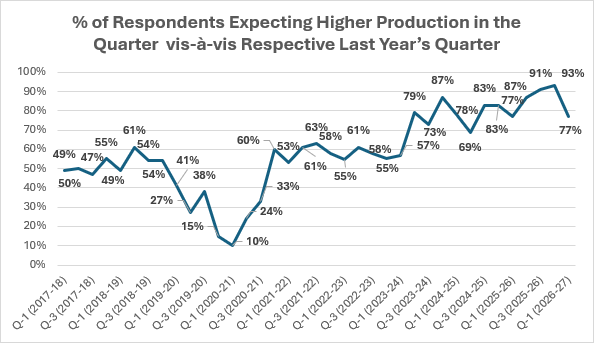
The latest edition of the FICCI Manufacturing survey reflects moderated sentiment for production in Q-1 2026-27 compared to the previous quarter indicating the potential impact of the West Asian crisis. Responses were based on expectations of the manufacturers reflecting the overall positive sentiments and stable domestic fundamentals for manufacturing growth. In comparison to Q4 FY 2025-26, when 93% of respondents reported higher or same production levels, approximately 77% of respondents reported either higher or same production levels in Q1 FY 2026-27. This moderation was also evident in demand, as 77% of respondents reported higher or same orders in Q1 FY 2026 as compared to 89% in the previous quarter.
FICCI’s latest Quarterly Survey on Manufacturing (QSM), which is the 70th edition of the survey, assessed the performance and sentiments for Q1 April-June 2026-27 of manufacturers for eight major sectors namely, Automotive & Auto Components, Capital Goods, Chemicals, Fertilizers & Pharmaceuticals, Electronics & Electricals, Machine Tools, Metal & Metal Products, Textiles, Apparels & Technical Textiles and Miscellaneous. Responses have been drawn from manufacturing units from both large and SME segments with a combined annual turnover of over Rs. 4 lakh crores.
Source: FICCI survey
Capacity Addition & Utilization
However, there was no major impact seen on the capacity utilization vis-à-vis the previous quarter. The existing average capacity utilization in manufacturing is close to 72%, which is similar to the capacity utilization in the previous survey. The future investment outlook is steady for the next six months. Challenges faced by respondents in expanding capacities include current geopolitical situation (tariffs, trade restrictions, demand uncertainty), operational issues (labour availability, raw material shortages, increasing logistic costs, regulatory challenges). The table below gives average capacity utilization for various sub-sectors of manufacturing:
Table: Current Average Capacity Utilization levels as reported in survey (%)
| Sector | Average capacity utilization (%) |
| Automotive & Auto Components | 65 |
| Capital Goods | 72 |
| Chemicals, Fertilizers & Pharmaceuticals | 76 |
| Electronics & Electricals | 70 |
| Machine Tools | 75 |
| Metal & Metal Products | 80 |
| Miscellaneous | 71 |
| Textiles, Apparels & Technical Textiles | 69 |
| Average Total | 72 (approx.) |
Inventories
In Q4 2025-26, around 86% of the respondents reported higher or same level of inventory and for Q-1 2026-27, around 85% of the respondents reported higher or same level of inventory.
Exports
In exports, about 61% of respondents reported higher or same level of exports in Q4 FY 2025-26 and in Q1 2026-27 around 74% of the respondents reported their exports to be higher or same as compared to previous year’s similar quarters. Export diversification efforts by government and industry seems to be yielding results.
Hiring
35% of the respondents are looking at hiring an additional workforce in the next three months as compared to 41% in the last quarter.
Interest Rate
The average interest rate paid by the manufacturers has been reported to be 8.9%, which is almost same as reported for the last quarter. A little over 89% of respondents reported sufficient availability of funds from banks for working capital or long-term capital.
Sectoral Growth
Based on expectations, the likely sectoral growth range is shown below:
Table: Growth Expectations for Q-1 FY 2026-27*
| Sector | Growth Expectation |
| Capital Goods | Moderate |
| Chemicals, Fertilizers & Pharmaceuticals | Moderate to Low |
| Electronics & Electricals | Moderate |
| Machine Tools | Strong to Moderate |
| Metal & Metal Products | Strong to Moderate |
| Miscellaneous | Moderate to Low |
| Textiles, Apparels & Technical Textiles | Moderate |
| Automotive & Auto Components | Moderate to strong |
* Very Strong >20%; Strong 10-20%; Moderate 5-10%; Low < 5%; Source: FICCI Survey
Production Cost
Production costs for manufacturers in this quarter seem to remain on higher side. Nearly 79% of respondents reported an increase in the cost of production as a percentage of sales, as against 70% in the previous quarter, indicating that costs pressures were higher in this quarter. The increase in cost of production compared to last year is mainly due to higher raw material costs, energy costs, currency depreciation, and increased logistics, and utility costs.
Workforce Availability
Most sectors are not facing shortage of labor at factories as around 63% of respondents mentioned that they do not have any issues with workforce availability. The remaining 37% feel that there is still lack of skilled workforce available in their sector and there is a need to step up efforts both at government and Industry level.