
India Extending Social Security Benefits To 101 Cr Citizens: Dr Mansukh Mandaviya

Share
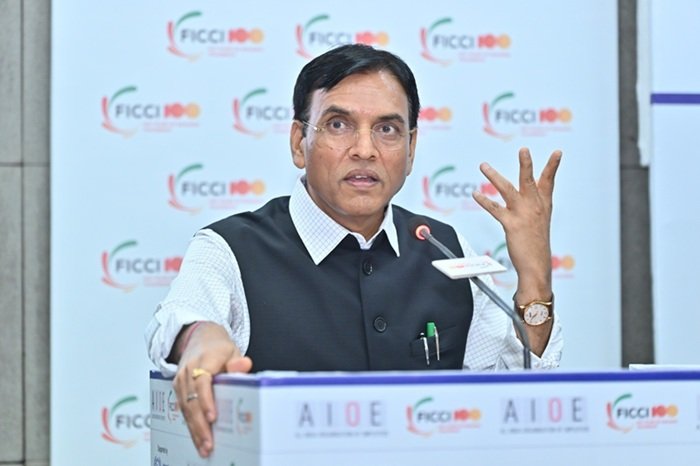
India’s social protection systems now cover about 101 crore people, or 68.8 per cent of the population, Dr Mansukh Mandaviya, Union Minister for Labour and Employment and Youth Affairs and Sports, said at the FICCI-AIOE 4th Global Industrial Relations Summit — a figure he said the International Labour Organization acknowledged at the BRICS labour ministers’ meeting last week. The Summit is organised by the All India Organisation of Employers (AIOE) in association with FICCI and ILO.
Dr Mandaviya noted that the employment generated per percentage point of GDP growth has risen from 0.1 per cent twelve years ago to 1.15 per cent in the last year’s data — a tenfold improvement in employment elasticity against the international benchmark for a balanced growth model. He attributed the shift to a reframing of industrial relations around four interdependent stakeholders — industry, government, trade unions and workers.
He noted that the policy now treats employers, workers and trade unions as mutually dependent partners in the same enterprise. He credited both industry and the trade unions with cooperating on the implementation of the four labour codes.
The Minister Dr Mandaviya also indicated that ESIC need not remain the sole provider of care under its own scheme. Well-run private hospitals could be designated as ESIC facilities, he said, describing further reform of the corporation as imminent. He also pointed to EPFO’s move to fully digital claims and automatic transfer of accounts on a single UAN, with UPI-based withdrawal under consideration.
Ms Michiko Miyamoto, Director ILO DWT for South Asia and Country Office for India, congratulated India on the expansion, noting that on ILO estimates the country had crossed one billion people covered by at least one of the nine social protection branches. She cautioned, however, that growth alone does not guarantee transition. Miyamoto urged a third wave of investment to follow physical and digital infrastructure: human capital, including AI literacy, continuous reskilling and far higher female workforce participation.
Mr. Jasbir Singh, President, AIOE & Executive Chairman, CEO and Whole Time Director, Amber Enterprises India, said industrial relations could no longer be treated as a dispute-resolution mechanism but must become a driver of productivity and competitiveness.
Ms Jyoti Vij, DG, FICCI, said technology, demography and geopolitics were together reshaping how, where and for whom work is organised. Mr Sanjay Bhatia, Past President, AIOE and Managing Director, Hindustan Tin Works, delivered the vote of thanks.