


Democracy, Dissent, Digital Silence: The Constitutionality Of Protests & Internet Shutdowns

Share
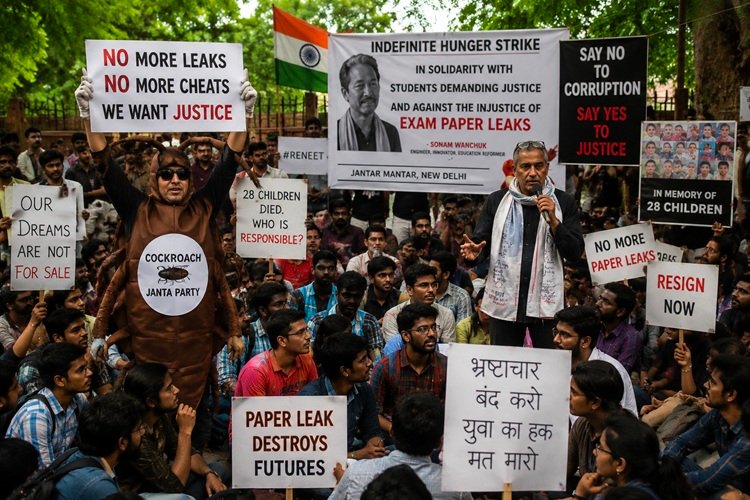
A democracy thrives not in the absence of dissent but in its ability to accommodate it. The right to protest peacefully is one of the most visible manifestations of democratic participation, enabling citizens to voice grievances, demand accountability, and influence public policy. In India, this right is constitutionally protected under Articles 19(1)(a) and 19(1)(b), which guarantee the freedom of speech and expression and the right to assemble peacefully without arms. Yet, in recent years, public protests have increasingly been met with restrictions ranging from prohibitory orders and detentions to internet shutdowns. These measures raise an important constitutional question: Can the State preserve public order by curtailing the very rights that define a constitutional democracy?
The Constitution does not treat the right to protest as absolute. Articles 19(2) and 19(3) permit reasonable restrictions in the interests of public order, the sovereignty and integrity of India, and the security of the State. However, “reasonable” cannot become synonymous with “convenient.” Every restriction imposed by the State must satisfy the constitutional test of legality, necessity, and proportionality.
The Supreme Court has repeatedly recognised that peaceful protest is a legitimate democratic right. In Himat Lal K. Shah v. Commissioner of Police, Ahmedabad (1973) 1 SCC 227, the Court held that while the State may regulate public assemblies to maintain order, it cannot impose arbitrary restrictions that effectively extinguish the right itself. This principle was reaffirmed in Ramlila Maidan Incident v. Home Secretary, (2012) 5 SCC 1, where the Supreme Court observed that the freedom of speech and peaceful assembly forms the foundation of democratic governance and that excessive use of State power against peaceful protesters is constitutionally impermissible.
At the same time, the Court has also clarified that protests cannot indefinitely obstruct public spaces. In Amit Sahni v. Commissioner of Police (2020) 10 SCC 439, it held that while dissent is indispensable in a democracy, demonstrations must balance the rights of protesters with the rights of the general public. Thus, constitutional jurisprudence attempts to strike a delicate balance rather than favour one right at the expense of another.
A more recent and equally significant constitutional concern is the frequent suspension of internet services during public demonstrations. In today’s world, the internet is not merely a communication tool; it is the primary medium through which citizens organise peaceful protests, access legal assistance, communicate with families, report incidents, conduct business, attend educational institutions, and seek emergency services. An internet shutdown therefore affects far more than the protest itself.
Recognising this reality, the Supreme Court in Anuradha Bhasin v. Union of India (2020) 3 SCC 637, 2020 SCC OnLine SC 25, AIR 2020 SC 1308, held that freedom of speech and expression and the freedom to practise any profession through the internet enjoy constitutional protection under Articles 19(1)(a) and 19(1)(g). The Court ruled that internet shutdowns cannot be imposed indefinitely and that every suspension order must satisfy the doctrine of proportionality. Orders must be reasoned, temporary, periodically reviewed, and capable of judicial scrutiny. Blanket restrictions imposed without demonstrating necessity cannot withstand constitutional scrutiny.
Despite these safeguards, internet shutdowns continue to be imposed during periods of civil unrest, often under the Temporary Suspension of Telecom Services (Public Emergency or Public Safety) Rules, 2017. While the objective of preventing misinformation and maintaining public order may be legitimate, blanket shutdowns often have consequences far beyond the immediate protest. Businesses suffer financial losses, journalists are unable to report independently, lawyers face difficulties communicating with clients and courts, students lose access to education, and ordinary citizens are deprived of essential digital services. Such restrictions affect millions who have no connection with the protests themselves.
The constitutional guarantee under Article 21 extends beyond mere survival; it encompasses the right to live with dignity, personal liberty, and security. This protection cannot disappear simply because an individual chooses to participate in a peaceful protest. Women, in particular, should not have to choose between exercising their democratic rights and safeguarding their personal safety. The State’s responsibility is twofold: to maintain public order while simultaneously protecting those who seek to express dissent peacefully.
The constitutional balance between individual liberty and collective welfare has also been recognised by the Supreme Court in Asha Ranjan v. State of Bihar (2017) 4 SCC 397. The Court observed that where two fundamental rights come into conflict, the test of larger public interest must guide the resolution, holding that the interest of the community or the collective social order may, in appropriate cases, outweigh an individual’s claim. However, this principle cannot be interpreted as granting the State unfettered discretion to suppress peaceful dissent. Rather, it requires a careful and proportionate balancing exercise in which restrictions are imposed only when they are demonstrably necessary to protect a legitimate public interest.
International human rights standards reinforce this constitutional approach. According to Article 19, an international human rights organisation dedicated to protecting freedom of expression and assembly, authorities must always strike a balance between the right to protest and the protection of the rights of others. Importantly, that balance should ordinarily favour the exercise of the right to protest unless there is compelling evidence justifying interference. Restrictions cannot be imposed merely because the views expressed are unpopular, politically inconvenient, or critical of those in power.
The same principle finds recognition in the 2020 General Comment No. 37 adopted by the United Nations Human Rights Committee on the right of peaceful assembly under Article 21 of the International Covenant on Civil and Political Rights (ICCPR). The Committee emphasised that inconvenience, economic disruption, or temporary obstruction of traffic are ordinary consequences of public assemblies and, by themselves, do not justify restricting peaceful protests. It further observed that a failure to respect and protect the right of peaceful assembly is often indicative of repression rather than democratic governance.
Ultimately, the legitimacy of a constitutional democracy is measured not by how effectively it controls dissent, but by how faithfully it protects it. Peaceful protest and digital access are no longer independent constitutional concerns; they are intrinsically linked in an era where public discourse, civic participation, and access to justice are increasingly mediated through technology. Internet shutdowns may, in exceptional circumstances, serve a legitimate public purpose, but they cannot become a routine administrative response to public demonstrations. Likewise, restrictions on protests must remain narrowly tailored, evidence-based, and proportionate, rather than tools to silence criticism or curtail political debate.
The challenge before constitutional democracies is not whether protests should be regulated; they undoubtedly can and should be when necessary, but whether the methods adopted by the State are proportionate to the objective sought to be achieved. Blanket internet shutdowns, indiscriminate restrictions, or excessive force risk transforming legitimate regulation into unconstitutional suppression.
Democracy is strengthened not by silencing disagreement but by engaging with it. Peaceful protest is not a disruption of democracy; it is democracy in action. Likewise, access to the internet has become indispensable for the meaningful exercise of modern constitutional freedoms. While the State possesses both the authority and the responsibility to preserve public order, that authority must always be exercised within constitutional limits.
The true test of a constitutional democracy is not how it responds to agreement, but how it responds to dissent. India’s Constitution does not promise a nation free from protest; it promises a nation where the voices of its citizens are heard, protected, and respected. In preserving that promise, the State must ensure that neither peaceful assembly nor digital freedom becomes the first casualty of public unrest.
Views expressed are personal.
The author, Anjali Labh, is an Advocate, LLM