

Cape Breton University Looks to Deepen India Ties as It Expands Academic Partnerships

Share
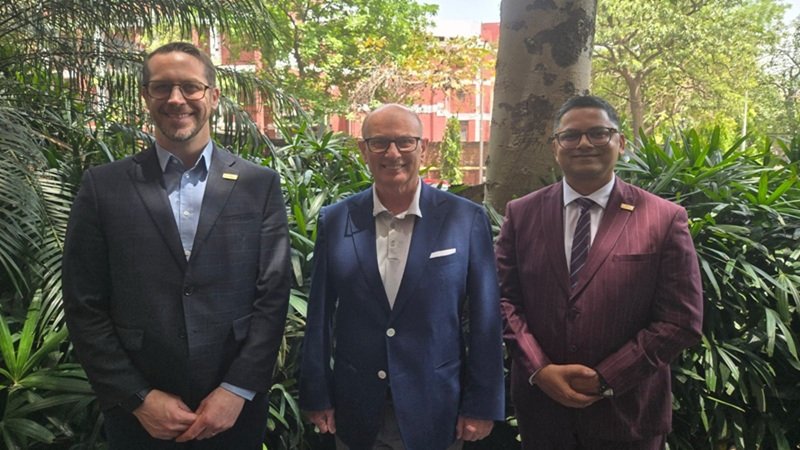
Most foreign universities that land in India are here for one thing — students. Fill the seats, meet the enrolment targets, fly home. Cape Breton University is trying to do something different, and its president made that clear the moment he sat down at the India Habitat Centre in New Delhi this week.
David Dingwall has been making the rounds — Delhi, Gurugram, Noida, Vadodara, Ahmedabad, Hyderabad — and the conversations he’s been having aren’t the usual recruitment fair variety. He’s been sitting across the table from Indian universities, policy bodies, and education stakeholders, asking a different question altogether: not “how do we get your students to come to us” but “how do we build something together that actually lasts?
It’s a subtle shift. But in the world of international higher education right now, it’s a significant one.
CBU is currently in talks with BML Munjal University, Parul University, Navrachna University, and LJ University, among others. The conversations are still early, but the models on the table include dual degrees, credit transfers, joint research, and collaborative programmes — the kind of arrangements where a student might spend part of their education in India and part in Canada, walking away with qualifications that carry weight in both countries.
Dingwall has been consistent on one point throughout the visit: India is not just a recruitment market for CBU. It never really was, he says — but the way international education is structured has historically made it feel that way. A student applies, gets a visa, flies to Nova Scotia, studies, and either stays or comes home. That’s the old model. And it’s creaking under the weight of a changed world.
The change has come from multiple directions at once. Canada tightened its immigration rules. Visa processing times stretched to the point where students gave up and looked elsewhere. The cost of studying and living abroad climbed. And back in India, there’s been a deliberate push — backed at the highest political level — to strengthen domestic higher education rather than simply export talent.
Prime Minister Modi has made it reasonably clear that he’d prefer Indian students to spend more of their academic years on home soil. That’s not a closed door for foreign universities — but it is a changed door. Institutions that don’t adapt to that reality will find themselves on the wrong side of it.
CBU’s response is to adapt. Rather than resist the shift toward home-based education, the university is trying to build itself into that ecosystem — as a partner to Indian institutions, not a competitor for their students.
The research angle is part of that too. Beyond student mobility, CBU is looking for genuine academic collaboration — joint research in areas tied to workforce demand and future industries. The university has already flagged healthcare, renewable energy, and technology as spaces where the two countries have overlapping needs and complementary strengths. Indian researchers and Canadian institutions working on shared problems, rather than simply exchanging students, is the direction CBU wants to move in.
The visit this week also included meetings with the State Council of Educational Research and Training in Telangana and the National Economic Forum — signalling that this isn’t purely a university-to-university conversation. CBU is trying to understand the policy landscape, not just the academic one.
None of this is unique to CBU. Universities across the world are quietly rethinking their India playbooks right now. The old model — show up at education fairs, sign a few MoUs, wait for applications — is losing ground to something more integrated and more durable. The institutions that figure out how to genuinely embed themselves in India’s academic ecosystem, rather than just draw from it, are likely to find themselves in a much stronger position five years from now.
Cape Breton University is a small institution from a quiet corner of Canada. It doesn’t have the brand recognition of a Toronto or a UBC. But it has something that might matter more in this moment — a willingness to show up, sit down, and think about India as a long-term partner rather than a short-term opportunity.
Whether the partnerships it’s building this week turn into something real will take time to see. But the instinct, at least, appears to be pointing in the right direction.