

Osho Mystic Rose Meditation Boosts Student Focus

Share
There is a strange arithmetic to the modern mind: the more we think, the less we live. We have become experts at postponing — postponing the tear that wants to fall, the laughter that wants to erupt, the silence that wants to settle. We carry these unexpressed guests inside us for years, sometimes for a lifetime, and we call this carrying “maturity.” Osho called it something else — a slow suffocation.
Mystic Rose is His answer to that suffocation. It is, in His own words, a meditation so simple that the mind cannot believe it works, and so deep that once it works, nothing remains the same.
The method has three steps each lasting seven days, three hours a day. The first seven days are for laughter — not the polite, controlled laughter society permits, but laughter without a reason, without an audience, without an apology. The second seven days are for tears — not grief performed, but tears finally allowed to arrive on their own terms, unexplained and unjudged. The last seven days are silence — not the silence of suppression we already know intimately, but a silence that is earned, a silence that arrives only after everything else has been emptied out.
This is why Osho called it a surgery. A surgeon does not negotiate with the wound; he opens it, let’s what needs to come out come out, and then closes it with care. Mystic Rose does the same with the years of pent-up emotion we mistake for our personality. By the end of it, what is left is not a person trying harder to be calm — it is a person who has nothing left to suppress, and therefore nothing left to fight.
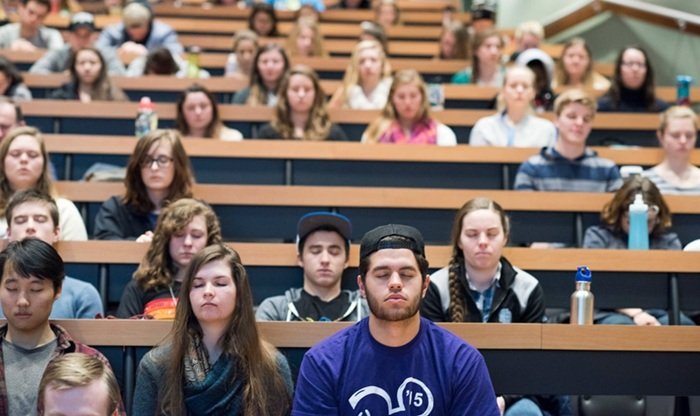
For young people especially, this has an effect that looks almost paradoxical: doing nothing but laughing, crying, and sitting in silence for three weeks produces sharper focus than any productivity technique they have tried. But it is not a paradox at all. Concentration was never really a skill the mind was missing — it was a capacity the mind never had room for, because it was busy managing what it had refused to feel. A student who has not cried in years is not calm; he is occupied — occupied by the very tears he is holding back, even while reading a textbook. Once that occupation ends, attention has somewhere to go other than inward, defensive circles.
This is what students discover after Mystic Rose: they can sit with a book and the book is simply there, without the usual static of unrelated anxieties humming underneath. They are able to study without constantly leaning into an imagined future — will I pass, will I succeed, will I be enough — because the part of them that needed reassurance has already received what it actually wanted: expression, not achievement. Stress, after all, is rarely about the task at hand. It is about the unfinished emotional business we drag into every task. Empty that business, and the present moment becomes available again. The student is simply there, doing the work in front of them, undistracted by ghosts.
There is something quietly subversive about this meditation, too. Society trains us early to believe that wholehearted laughter is excess, that loud tears are weakness, that anything unmeasured is a little mad. Osho saw this conditioning for what it is — a slow theft of our aliveness — and built a method to give it back.
People from across the world now travel to Osho Dham in Delhi for this purification, and return changed — not louder, not more emotional, but lighter, clearer, more themselves. They carry back with them an inner permission: to feel fully, so they can finally think clearly; to empty completely, so they can finally be present.
Mystic Rose is Osho’s gift to a generation taught to perform wellness instead of living it. It asks for nothing more than twenty-one days and an honest willingness to feel — and in return, it offers something most of us have forgotten was ever possible: a mind that is quiet not because it has been controlled, but because it has, at last, nothing left to hide from.
Views are personal
The author, Ma Dhyan Prachi, is a meditation facilitator at Osho Dham