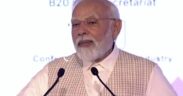


At G7, Modi Calls For Shared Prosperity And Global Partnerships

Share
The Prime Minister rose to speak with a conviction rooted not in political calculation, but in civilizational memory. India’s journey, he said, was never merely about one nation’s ambitions. “When India progresses,” he declared, “one-sixth of humanity progresses with it.” This was not a boast. It was a responsibility — and a promise.
For twelve years, he explained, India had been guided by a single, enduring principle: Sabka Saath, Sabka Vikas, Sabka Vishwas, Sabka Prayas — Together with all, Development for all, Trust of all, Efforts of all. It was a philosophy that had shaped not just domestic policy, but India’s entire engagement with the world. India’s growth story, he insisted, was fundamentally “a story of inclusion, scale, and democratic empowerment for all.”
When India chaired the G20, the Prime Minister had carried this spirit to the world stage. The message was simple and ancient at once: One Earth, One Family, One Future. “This was not merely a slogan,” he said firmly. “It was an expression of our civilizational ethos that views the entire world as one family.” The words carried the weight of thousands of years of Indian thought — the Vedic vision of Vasudhaiva Kutumbakam, the world as kin.
It was from this same spirit, he recounted, that India had helped launch the India–Middle East–Europe Economic Corridor — IMEC — a historic undertaking connecting Asia, the Middle East, and Europe. This was not a corridor of control, he was careful to say, but one of connectivity: one that would “accelerate trade, strengthen supply chains, and create new opportunities for investment, employment, and innovation.” And the model for all such initiatives must be built, he stressed, on “local ownership, transparent financing, and a clear vision for long-term sustainability.”
But the Prime Minister did not stop at celebrating what had been achieved. He turned, with visible concern, to what was being endured.
The crisis in West Asia, he said, had fractured the flow of fuel, fertilizer, and food — lifelines for the most vulnerable nations on earth. These disruptions would “continue to have a significant impact on the Global South for some time.” If international solidarity was to mean anything at all, he argued, “the most vulnerable countries should not be left to bear the burden of these crises alone.” He called on international financial institutions to build support mechanisms that could help developing nations absorb such shocks and preserve their economic resilience.
Then the Prime Minister painted a picture of possibility.
Drawing inspiration from the IMEC vision, he proposed extending the model to Africa, Latin America, and the Pacific Islands — entire regions waiting to be connected to the world’s prosperity. He put forward the idea of IMPACT: the International Mobilisation Partnership for Accelerating Connectivity and Trade. By bringing together, in his words, “the capital of the G7, the talent of India, and the ownership of countries across the Global South,” this partnership could build corridors linking “trade, technology, energy, and opportunity.”
He turned then to a quieter, deeper complementarity — one that he believed held enormous promise for both the developed and developing world. While the industrialised nations grappled with ageing populations, India and the Global South brimmed with young energy, enterprise, and skill. To harness this natural fit, he proposed a Global Skills Partnership — a framework for skill mapping and trusted skilled mobility, designed to meet the needs of both sides with dignity.
None of this, the Prime Minister was clear, was rhetoric without record. India had concluded trade agreements with most of the countries in the room. This, he said, spoke to something deep in India’s worldview: a belief “not in fragmentation, but in integration, not in protectionism, but in partnership, and not in uncertainty, but in shared prosperity.”
As he closed, the Prime Minister looked ahead with characteristic steadiness. India, he pledged, would continue working alongside every partner in that room — to strengthen shared economic resilience, and to build what he called a “more stable, reliable, and prosperous global economy.”
It was, in the end, the speech of a leader who understood that the most durable power is the kind that lifts others as it rises — and who had staked his nation’s legacy on proving that very thing to the world.