

In Conversation With Prof. S. Vijaya Bhaskara Rao, Vice-Chairman, APSCHE

Share
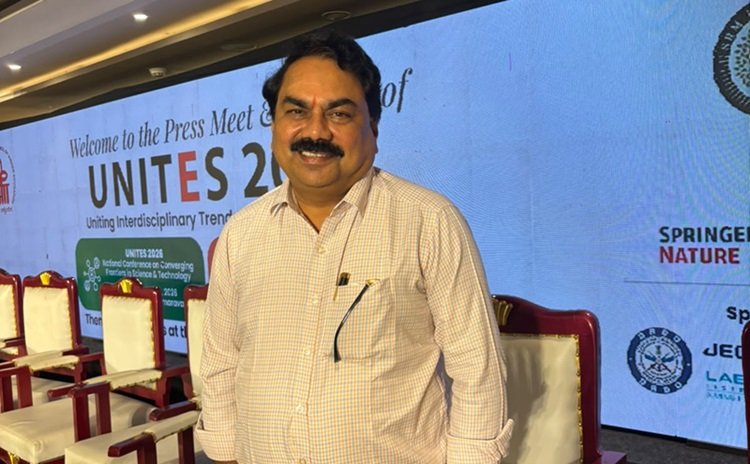
As Andhra Pradesh positions Amaravati as an emerging educational and scientific hub, and as institutions across the state prepare to rally behind ambitious new initiatives like UNITES, questions about funding, access and equity inevitably follow. Who actually benefits when a state invests in research? Does a student in a small-town degree college get the same shot at doing meaningful science as one studying in the capital? And what does it really take to convince a talented young researcher to stay in the lab, rather than take up a teaching job just to pay the bills?
We sat down with Prof. S. Vijaya Bhaskara Rao, Vice-Chairman of the AP State Council of Higher Education, to unpack these questions. A physics professor himself, and someone who has previously served as Dean of Research and Development, Prof. Rao speaks candidly about the state of research funding in Andhra Pradesh, the effort to decentralise lab access beyond Amaravati, the persistent struggle to fund young and mid-career researchers, and — perhaps most passionately — why he believes the fear surrounding subjects like physics has less to do with the subject itself, and everything to do with how it’s taught.
Edited excerpts:
Q: What policy frameworks or incentives are currently being introduced to encourage state universities in AP to ramp up collaborative research, faculty exchange and global academic partnerships?
A. Universities shouldn’t hesitate to pursue research. They can apply to central government agencies, get funding, and execute their projects. We’re also supporting this through RUSA (Rashtriya Uchchatar Shiksha Abhiyan), and many degree colleges and universities have received grants under it, somewhere around 400 to 500 crore has gone toward this. The MERU project is also running at the state level, and the DST is supporting it as well. That said, the actual quantum of funding is limited, getting projects sanctioned has become harder in recent years due to various constraints, though some money is still available, including through examination fees and similar sources.
Beyond funding, we have time-bound promotions tied to publications, patents and similar output. We also give out Best Teacher awards, and there’s some support for faculty to travel abroad, attend workshops and build those kinds of connections. Individual institutions are expected to build their own facilities too, though the state has supported many universities in setting up central facilities under RUSA. That’s helped build hostels, infrastructure and labs. But to be clear, the state government isn’t directly funding research in large amounts, most of its support goes toward salaries and running costs.
Q: As Amaravati develops into an emerging educational and scientific hub, what measures are being taken to ensure students from rural or economically disadvantaged backgrounds have equitable access to these opportunities?
A: This is exactly why the state government has made the call that every degree college should be able to set up its own labs, with grants of around 5 to 10 lakhs, and DST is supporting this too. The idea is that opportunities shouldn’t be concentrated only in Amaravati. Students should be able to access labs at their nearest degree college instead of having to travel. Some of this is already happening, around ten labs have been established across different degree colleges so far, and the plan is to keep expanding this over time so that the urban-rural divide you’re describing doesn’t take hold.
Q: How does the state see the role of institutional autonomy in fostering innovation, and what regulatory flexibilities can universities expect as they try to launch interdisciplinary initiatives like UNITES?
A: NEP 2020 already gives universities a lot of freedom here. There’s no restriction on taking a multidisciplinary approach or introducing new courses; universities have full autonomy to start programmes. The only time they need government approval is when there’s a financial implication involved. Otherwise, they’re free to design courses, seek funding, and move ahead on their own.
When it comes to something like UNITES specifically, our thinking is that motivation for science needs to start from the school level all the way up through degree college. Right now, science isn’t attracting enough interest; everyone is drawn toward technology-oriented fields instead. So we want to organise talks, exhibitions, hackathons, things that build science talent among students. We also need to support science teachers directly, through training and orientation, so they can teach more effectively. We’ve already run several workshops on this, including how AI can be used in teaching. That’s the kind of work this society can do, in some ways, it’s a skill-development effort as much as anything else.
Q: On digital infrastructure — as higher education increasingly relies on advanced technology, what state-level initiatives are in place to bridge the digital divide?
A: Even with something like AI, or programming and coding, people assume you need an expensive desktop, maybe a lakh or a lakh and a half. But that’s not really the barrier anymore. A basic desktop costing 4 to 5 lakhs [for a lab setup] paired with server access is enough to get real work done. You don’t need to worry about running expensive, high-powered machines individually. So logistically, I don’t think this is a major issue anymore.
Q: When it comes to research specifically, very few students actually want to pursue it. How do we motivate this generation, who often have their own priorities, to consider a career in research?
A: This is something I’ve thought about a lot, going back to when I was Dean of Research and Development. If a student isn’t given any fellowship or financial support, how is he supposed to survive? He still has to pay his hostel fees, cover contingency costs, everything. At the very least, he needs something like ₹10,000 a month just to stay in the hostel and focus on his work. Without that, his only option is to go teach at a college for a couple of hours a day just to earn money, and come back in the evening to squeeze in an hour or two of research. You can’t expect real output from that kind of arrangement, and you can’t blame the student either. He’s not wrong for saying, “I need money, and you’re not giving me any.”
So there has to be some kind of incentive, whether from the state government or the universities themselves. At minimum, talented students who rank well in competitive exams should get some support, ₹10,000 or ₹15,000, on top of whatever they might already get through CSIR or similar bodies.
Q: What about someone older, say around 40, who decides later in life that they want to pursue research? They wouldn’t qualify for a JRF or most standard scholarships. How can they be supported?
A: That’s genuinely difficult. Very rarely, they might find an industry-sponsored project, and central government-funded opportunities for someone in that position are even rarer. This goes back to what I was saying earlier, universities need to set aside at least some portion of their own funds for research. Otherwise, your rankings won’t improve, not NIRF, not QS. Everyone asks how many Indian universities make it into global rankings, but that doesn’t happen unless institutions actually invest in it.
The problem is that most of a university’s revenue goes straight into salaries, leaving nothing for development. Some prioritisation has to happen, and that has to be a decision: this is our revenue, how do we choose to spend it? That’s something we leave entirely to the universities; we don’t interfere in that.
Q: Many students who are genuinely interested in research end up intimidated by subjects like physics and chemistry, even when they’re capable of doing well in them. Is there a way to ease some of the rigid criteria around these subjects, so that more genuinely interested students aren’t discouraged from pursuing research?
A: This fear is manufactured, honestly. Even today, when people talk about entrance exams, they’ll tell you physics is the hardest subject. That’s not really true. I’m a physics professor myself, if physics is taught properly, students understand it just fine. If the teaching is weak, of course physics will feel intimidating. You have to genuinely love teaching the subject for it to land.
Look at how universities like Harvard approach this: they use real examples to explain how something works before jumping into equations. The moment you throw pure mathematics and formulas at people first, that’s when the fear sets in. So really, it comes down to changing how we teach, not the subject itself.
Q: Any message for students who genuinely want to pursue research?
A: My honest advice is: identify a real societal problem. Don’t chase the kind of research where someone else has already done the work and you’re just making small modifications to it. That kind of research doesn’t sustain itself, and it won’t produce anything meaningful in the long run.
Instead, identify your problem first, and visualise what the actual outcome of your research should be. If you can picture that clearly, you can plan your work around it. Ideally, right after your PhD, your research should be something transferable, either as usable technology or something directly applicable to society, whether that’s in biology, health, engineering, or any other field.
Otherwise, you’re just doing research for the sake of publishing, or for the sake of finishing a PhD. And that only gets you a number. We already talk about how India ranks third globally in the number of publications, but where do we stand in terms of patents? That’s the real measure. Quality matters far more than quantity.